Concrete sand filters are among the most common and durable water treatment systems used in industry and municipalities. By combining the advantages of concrete as a building material with sand as a filter medium, these filters offer a cost-effective solution for cleaning large volumes of water. This article provides a comprehensive overview of the properties, advantages, disadvantages, and applications of concrete sand filters.
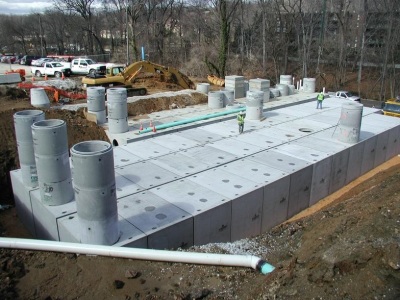 Design and construction of sand filters for concrete
Main components
-
Special topic :
-
Material: Reinforced concrete, compressive strength of 25 to 35 MPa.
-
Wall thickness: 20-40 cm, depending on size.
-
Interior lining: Epoxy resin or modified cement.
-
-
Water supply system :
-
Raw water distribution channels
-
Evenly distributed nozzles
-
-
Filter layer :
-
Sand layer depth: 60-120 cm
-
Particle size: 0.4–1.2 mm
-
-
Wastewater system :
-
gravel support layer
-
Pure water collection system
-
Design type
-
Rectangular filter :
-
The most commonly used type in large processing plants.
-
It can be built on site (the concrete is poured on site).
-
-
Ready-made round filters :
-
Suitable for medium-sized projects.
-
Faster installation
-
-
Multi-block filter :
-
Modular design
-
Stage management skills
-
Advantages of sand filters for concrete
1. High strength and long service life.
-
Estimated service life: 40-50 years
-
Resistance to various climatic conditions
-
It is less corrosive than metal filters.
2. Large-scale projects are characterized by high economic efficiency.
-
The costs for mass production are lower than those for metal filters.
-
Low maintenance costs in the long term
3. Structural stability
-
High hydraulic resistance
-
Load-bearing capacity of the filter layer and its accessories
-
Earthquake safety (with suitable construction)
4. Design flexibility
-
Capable of producing products in various sizes and shapes.
-
Ability to adapt to local conditions
5. Optimal thermal properties
-
Natural thermal insulation prevents temperature fluctuations.
-
Reduce the influence of ambient temperature on the cleaning process.
Disadvantages and problems
1. Construction period
-
The time required for pouring and hardening the concrete.
-
The influence of climatic conditions on the construction process.
2. Heavyweight
-
A suitable foundation is required.
-
Restrictions for installation in high-rise buildings
3. The seal must be tightly closed.
-
Leaks can occur at building joints.
-
Special coatings are required to prevent water leaks.
4. Limitations in maintenance
-
Implementing comprehensive reforms is no easy task.
-
Special experience in concrete repair is required.
Construction and installation process
Construction phases
-
Basic preparations :
-
Drilling and pressing
-
Application of steel mesh
-
-
Formwork and concrete :
-
Use metal or wooden molds.
-
concrete walls and slabs
-
-
Concrete processing :
-
Keep the surface moist for 7-14 days.
-
To prevent freezing in cold climates
-
-
Installation of internal equipment :
-
Water collection system
-
Distributor injectors
-
Communication channels
-
-
Leakage test :
-
Fill it with water and make sure it is leak-proof.
-
Stress test
-
Main applications
1. Municipal wastewater treatment plants
-
The final cleaning step after sedimentation.
-
Remove all remaining suspended particles.
2. Large-scale industry
-
thermal power plant
-
Oil refineries and petrochemical plants
-
steel and mining industry
3. Wastewater treatment
-
The third stage of municipal wastewater treatment
-
Industrial water recycling system
4. Major construction projects
-
Dams and water supply networks
Maintenance and operation
Preventive maintenance plan
-
Regular checks :
-
Check for surface cracks.
-
Check the condition of the inner lining.
-
-
Regular cleaning :
-
Cleaning the filter layer
-
clean waterways
-
-
Check the mechanical system :
-
Valves and control devices
-
Ventilation system (if present )
-
Common problems and solutions
-
Surface cracks :
-
Reasons: Concrete shrinkage or foundation settling.
-
Solution: Epoxy resin injection.
-
-
Leaks at welded joints :
-
Reason: Malfunction in the water leakage prevention system.
-
Solution: Repair using polymer materials.
-
-
Internal erosion of the cladding :
-
Causes: mechanical or chemical corrosion.
-
Solution: Reapply the protective layer.
-
Design and construction standards
International Standards
-
AWWA B100-09 :
-
Standards for sand filtration published by the American Water Works Association .
-
-
EN 12904:2005 :
-
European standards for materials used in water treatment
-
-
ACI 350 :
-
Standards of the American Concrete Institute (ACI) for concrete structures in contact with water.
-
Design considerations for Iran
-
National Building Code :
-
Topic 9 ( Planning and construction of reinforced concrete buildings)
-
-
Guidelines of the Ministry of Energy :
-
Design standards for water treatment and wastewater plants
-
-
Specific environmental conditions :
-
seismic resistance
-
It adapts to different climatic conditions.
-
Innovations in sand filters for concrete
1. High-performance concrete (HSC)
-
Increased compressive strength (up to 70 MPa)
-
Improved water resistance
-
This ensures increased resistance to aggressive environments.
2. Nanocoating
-
High corrosion resistance
-
It possesses algae-inhibiting and antibacterial properties.
-
Reduction of surface friction
3. Intelligent monitoring system
-
Sensors are embedded in concrete.
-
Electronic monitoring of the condition of buildings
-
Automatic alarm system
Compared to other types of sand filters
| Special feature | Concrete filter | Metal filter | Polymer filters |
|---|---|---|---|
| Life | 40-50 years old | 15-25 years old | 10-15 years |
| Initial costs | half | higher | fewer |
| compressive strength | Very large | higher | half |
| Corrosion-resistant | Yes | Medium (without case) | Great |
| Construction/installation time | long | half | short |
| maintainability | I ask | half | base |
| The right size | large | Medium and large | Small and medium-sized enterprises |
In conclusion
Concrete sand filters play a vital role in water and wastewater treatment , offering a sustainable and cost-effective solution for large-scale water purification. Despite challenges such as long construction times and significant weight, these filters are extremely durable, have low operating costs, and offer design flexibility, making them ideal for infrastructure projects. Recent advancements in concrete technology and monitoring systems have significantly improved the performance and lifespan of these filters. For large-scale water treatment projects requiring long-term, cost-effective solutions, concrete sand filters remain among the best options.