Introduction: The important role of the reservoir in the compacted sand filter.
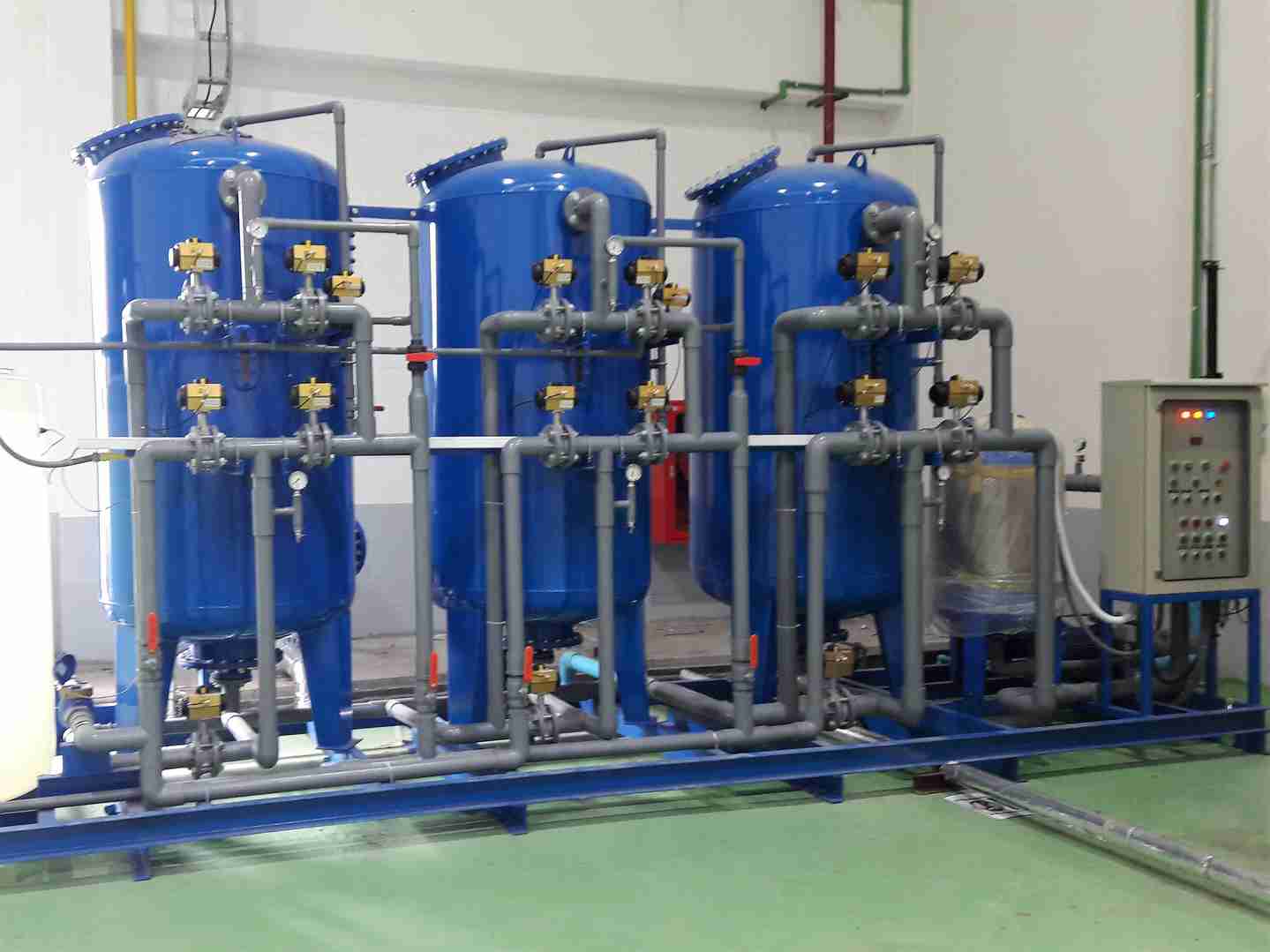
The main chamber or tank of a compact sand filter is the heart of the filter system. This area not only contains the filter material but must also withstand high operating pressures. The design and construction of this tank directly influence the overall performance of the filter system.
Main fuel tank – design and components
1. Main tank
• Material : Typically carbon steel , stainless steel 304 or 316 , or glass fiber reinforced plastic (GFRP)
• Thickness : 6 to 20 mm, depending on operating pressure
• Lining : Epoxy resin, natural rubber, or polyurethane for corrosion protection
2. Inspection opening (accessible point)
• Standard diameter from 400 to 600 mm
• With seal
• Some models available with viewing window
3. Water supply system
• Base distribution plate : Usually made of stainless steel or corrosion-resistant polymer.
• Distribution nozzles : The number of nozzles varies between 50 and 100 depending on the tank size.
• Central distribution pipe : Ensures even water distribution during backwashing.
4. Connections and valves
• Inlet and outlet with flanged connections
• Vent valve at the highest point
• Sampling valve for quality control
Standards for the design and construction of storage tanks
International Standards:
• Pressure vessels comply with ASME Section 8
• Compliant with EN 13445
• Pressure equipment complies with the Pressure Equipment Directive 2014/68/EU
Key design criteria:
-
Operating pressure : typically 2 to 10 bar.
-
Test pressure : 1.5 times the operating pressure.
-
Operating temperature : from -10 to 80 degrees Celsius.
-
Safety factor : at least 4 for carbon steel.
Panzer construction B
1. Vertical storage tank
• Suitable for confined spaces
• Large height relative to diameter
• More even pressure distribution
2. Horizontal storage tank
• Requires more lateral space
• Easier to maintain
• Better mechanical stability
3. Double-walled tank
• Suitable for special applications requiring thermal insulation
• Prevents condensation in high humidity
• Improved temperature control
The process of building a sand filter
1. Cutting and shaping of sheet metal.
• High precision thanks to numerical control (CNC)
• Bending with a hydraulic press
2. Welding the bodywork
• Argon welding of stainless steel
• Submerged arc welding of carbon steel
• Radiographic quality control of welds
3. Final payment
• Sandblasting of surfaces
• Application of industrial epoxy resin
• Installation of fasteners
 Factors that influence the choice of material for storage tanks.
-
Type of liquid : Drinking water, wastewater, chemicals.
-
Environmental conditions : humidity, ambient temperature, solar radiation.
-
Health topics : Food and pharmaceutical industries
-
Financial constraints: Acquisition and maintenance costs .
Technical calculations for tanks
Calculation of wall thickness:
Using the formula given in Section 8 of the American Society of Mechanical Engineers (ASME) standards:
t = (P * R) / (S * E – 0.6 * P)
Where:
• t: Wall thickness (mm)
• P: Design pressure (bar)
• R: Inner radius (mm)
• S: Allowable stress of the material (MPa)
• E: Welding efficiency
Calculation of the effective volume:
V = π*r²*h*0.8 (fill factor)
Regular maintenance and inspection
Check the schedule:
• Daily : Pressure and leak test
• Monthly : Paint condition check
• Annually : Hydrostatic pressure test and ultrasonic testing for material defects
Precautions:
• Regular backflushing
• Replace seals every two years
• Prevent corrosion on welds
Common problems and solutions
-
Localized erosion :
• Cause: Defects in the protective coating
• Solution: Repair of the protective coating and sandblasting. -
Stress cracks :
• Cause: Repeated loading cycles
• Solution: Reinforcement of critical areas -
Leakage at the edge :
• Cause: Screws not tightened properly
• Solution: Use a new seal
Forecasts in reservoir planning
-
Use of modern composite materials
-
Intelligent sensors for monitoring tank conditions.
-
Modular design, simplified installation.
-
Improved flow through hydrodynamics
In conclusion
The main chamber, a key element of a pressurized sand filtration system, requires precise design and high-quality workmanship. Selecting appropriate materials, adhering to construction regulations, and regular maintenance significantly contribute to extending the system’s service life and improving its efficiency. Thanks to recent advancements in materials and manufacturing technologies, modern tanks offer improved performance and durability compared to previous generations.
Technical recommendations: For larger projects, you should definitely consult an experienced pressure vessel designer and request standard certifications from the manufacturer.