Pressure vessels are essential components in industrial plants, water treatment plants, and liquid storage facilities. These vessels are available in both vertical and horizontal configurations . The choice of the appropriate type depends on the environmental conditions, the installation location, and the technical requirements. This article provides a comprehensive comparison of vertical and horizontal pressure vessels , outlining the key differences, advantages, disadvantages, and applications of both types.
1. Main differences between vertical and horizontal pressure vessels
a) Structure and design
-
Vertical tank:
-
It was constructed in the shape of a cylinder, the height of which exceeded its diameter.
-
It typically occupies a smaller surface area.
-
Suitable for rooms with limited horizontal space.
-
-
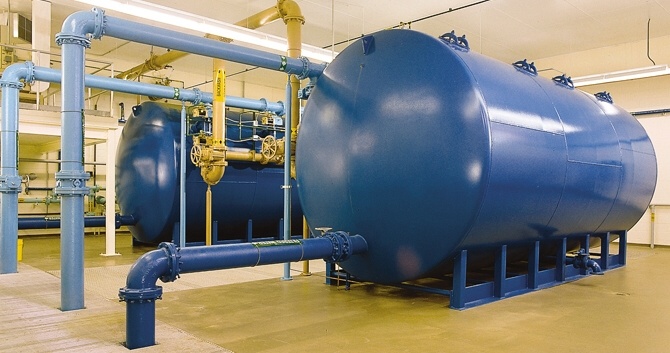
Horizontal tank:
-
It had a horizontal cylindrical shape and was relatively long.
-
A larger assembly area is required.
-
Peripheral devices such as valves and precision instruments are easily accessible.
-
b) Frequent uses
| Tank type | Common uses |
|---|---|
| vertical | Water treatment plants, sand filters, water storage tanks and chemical plants in confined spaces. |
| horizontal | Pipelines for the transport of liquids, compressed air tanks, boilers, and the oil and gas industry. |
 2. Advantages and disadvantages of vertical and horizontal tanks
Vertical high-pressure tank
 Special feature:
-
It doesn’t take up much space (suitable for small rooms).
-
It can easily be installed even in small rooms.
-
In some cases, the pressure distribution is more even.
-
In some cases, the costs are lower (due to the simpler construction).
 Shortage:
-
Repairing devices is a more complex task .
-
A great height is required for installation .
-
Very high throughput limits .
horizontal high-pressure tank
Special feature:
-
Convenient access to parts and valves .
-
It exhibits higher earthquake resistance .
-
Some models have greater performance capabilities.
-
It can be installed on a stationary or mobile base .
Shortage:
-
It needs more space .
-
A stronger foundation is needed .
-
In some cases, the construction and installation costs are high .
3. Technical comparison of vertical and horizontal tanks.
| Special feature | Vertical tank | horizontal tank |
|---|---|---|
| Required space | fewer | additionally |
| Access device | Restricted | The easiest way |
| Mechanical stability | Suitable for pressure equalization. | Increased seismic resistance |
| Construction costs | usually cheaper | It could be more expensive. |
| Storage capacity | Suitable for medium capacities | Suitable for large quantities |
| Application in cleaning systems | Sand filter, reverse osmosis | Pipelines, compressed air tanks |
4. Factors influencing the selection of pressure vessels (vertical or horizontal)
-
Installation location restrictions:
-
When space on the sides is limited, a vertical water tank is the best option.
-
Provided there is enough space, a horizontal water tank would be the most suitable option.
-
-
Pressure and temperature:
-
Horizontal tanks exhibit better resistance to extremely high pressure.
-
Vertical tanks are better suited for pressure equalization .
-
-
Liquid type:
-
For liquids containing solid particles (e.g., sand filters), the use of vertical tanks is preferable.
-
Horizontal tanks can be more efficient for transporting gases and liquids.
-
-
Costs and maintenance:
-
Vertical tanks are characterized by low maintenance costs.
-
Horizontal tanks are easier to maintain because they are easily accessible.
-
 5. Special applications for different tank types.
a) Vertical storage tanks:
-
Water and wastewater treatment systems (sand filters, activated carbon, reverse osmosis).
-
Storage tanks for drinking and process water .
-
Food and pharmaceutical industries (through healthier design).
b) Horizontal storage tanks:
-
Storage of compressed air and gas (compressor).
-
Oil, gas and petrochemical industries .
-
Steam boilers and heat exchangers .
6. Summary and Conclusion
-
When space is limited and a compact system is needed, a vertical water tank is the best option.
-
If easy access to the equipment and ease of maintenance are important, then a horizontal tank is the
-
The two types of water tanks are used in various industries, with the final choice depending on project requirements , budget, and environmental conditions.
7. Frequently Asked Questions (FAQ)
1. Which type of water tank is best suited for a water treatment plant?
It depends on the available space, but in general a vertical tank is best suited for filtration.
2. Are horizontal storage tanks more expensive?
Yes, in some cases they are more expensive because their construction is more complex and requires a more stable foundation .
3. What pressure is optimal for a vertical tank?
They are typically designed for a pressure range of 2 to 10 bar , but industrial models can withstand higher pressures.
4. What is the service life of a pressure vessel?
With proper maintenance, the lifespan can be 10 to 20 years, depending on the construction material (steel, fiberglass or stainless steel ) .
8. Concluding Remarks
The choice between vertical and horizontal pressure vessels depends on various factors, including installation location, operating pressure, type of medium, and cost. Consultation with renowned engineers and manufacturers will help you find the optimal solution for your project.
We recommend that you contact our experts for pricing information and technical advice.
Keywords:
Vertical pressure vessel, horizontal pressure vessel, differences between vertical and horizontal pressure vessels, pressure vessel price, sand filter, industrial vessel selection