Pressure sand filters are essential components in water and wastewater treatment plants and are available in both vertical and horizontal configurations . Horizontal pressure sand filters, due to their unique design, are widely used in various industries. This article will examine the construction of horizontal sand filters, their advantages and disadvantages, their applications , and analyze the differences compared to the vertical model.
1. What is a horizontal pressure sand filter?
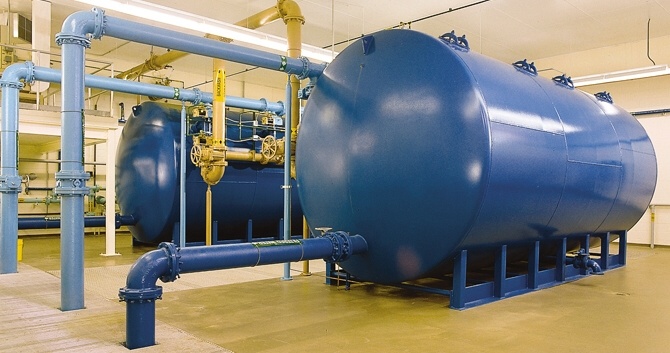
Horizontal pressure sand filters are a physical filtration system in which pressurized water is forced through a sand bed to remove suspended solids and turbidity. These filters are shaped like horizontal cylinders and are suitable for high flow rates.
The main components of a horizontal sand filter:
-
Horizontal tank made of steel or fiberglass (withstands pressures up to 10 bar)
-
Silicon dioxide layer and anthracite carbon layer (with different particle sizes)
-
Water distribution system (steel or polymer nozzles)
-
Flow control valve (manual or automatic)
-
Backwash wastewater drainage system
-
Pressure gauge and display
2. Operating principle of a horizontal sand filter
a) Nomination phase:
-
Contaminated water entered the tank from one side.
-
By penetrating the sand layer , it is possible to remove suspended particles with a size of 20 to 50 micrometers.
-
Clean water comes from the other side of the tank.
b) Backwash phase:
-
Once the filter is saturated with moisture, the direction of the water flow changes.
-
To separate the particles, water is pumped out from below under high pressure.
-
Pollutants are removed via the exhaust system.
 3. Advantages of horizontal sand filters compared to vertical sand filters
 Lower building height (suitable for sites with height restrictions),
easier access for maintenance of internal equipment,
higher earthquake resistance and the possibility in some projects to achieve
extremely high flow rates and a more uniform water distribution.
4. Disadvantages and limitations
 It requires more width than a vertical model. Construction and installation costs are higher. In some cases, horizontal construction requires a more stable foundation.
5. Use of horizontal sand filters
-
Water treatment in swimming pools and water parks
-
Pretreatment of reverse osmosis (RO) systems.
-
Oil, gas and petrochemical industry
-
Treatment of well and river water for industrial purposes.
-
Water circulation systems in the food industry
6. Comparison of horizontal and vertical sand filters.
| Special feature | Horizontal filter | Vertical filter |
|---|---|---|
| Installation area | More lateral space is needed. | More vertical space is needed. |
| It’s worth it | overall higher | usually cheaper |
| capacity | Suitable for high flow rates . | Suitable for medium flow rates. |
| This is suitable | More convenient access | Access is more restricted. |
| Common uses | Oil and gas industry, large systems | Treatment facilities, swimming pools |
7. Tips for selection and care
-
Suitable silica particles (usually 3 layers of different sizes).
-
Regular pressure monitoring (the difference between inlet and outlet pressure should not exceed 0.5 bar).
-
Perform regular cleaning (every 48-72 hours of continuous operation).
-
Check the fuel tank for corrosion annually.
8. Conclusion
Horizontal sand filters with pressure vessels are ideal for large industrial projects requiring high throughput, easy accessibility, and mechanical stability . Although these filters require more space , their operational advantages often justify this limitation.
Recommendation: For projects with a water flow rate of 50 cubic meters per hour or more, a horizontal filter is usually the best option.
9. Frequently Asked Questions (FAQ)
1. What are the main differences between horizontal and vertical filtration?
The main difference lies in the type of water tank and the space required . Horizontal filters are better suited for rooms with low ceilings.
2. What is the expected lifespan of these filters?
With proper maintenance, the lifespan can be 10 to 15 years, depending on the tank material (steel or fiberglass) .
3. Can horizontal filters be used in swimming pools?
Yes, these filters are an excellent choice for large swimming pools and water parks.
4. What is the standard operating pressure for these filters?
Depending on the design and application, this value is usually between 3 and 10 times higher.
10. Final Conclusion
The choice between horizontal and vertical sand filters depends on the available space, the required flow rate, and the project budget . Although horizontal filters require more space, they are more efficient in large industrial plants .
 Contact our experts for advice and pricing information.