Introduction: The importance of pool water filtration
For clean and clear pool water, an effective filter system is essential. Sand filters are the most common and cost-effective method of pool water filtration. This system plays a crucial role in water quality by removing suspended particles and physical impurities.
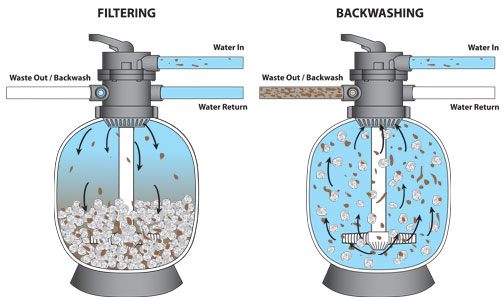
This is how a sand filter for swimming pools works.
The operating principle of a sand filter for swimming pools is based on the fact that water is passed through a layer of quartz sand:
-
The polluted water is pumped from the basin to the filter.
-
The water penetrates the sand layer under pressure.
-
Particles get trapped between the grains of sand.
-
The purified water is returned to the pool.
Important point: The filtration rate is typically 20 to 50 cubic meters per square meter of filter surface per hour.
 The main components of a sand filter system for swimming pools
1. Filter tank
• Material: Usually made of fiberglass or reinforced polyethylene.
• Size: Depending on the tank’s capacity, the diameter varies between 400 and 1200 mm.
• Equipped with an inspection hatch and control valves.
2. Filter layer
• The grain size of the quartz sand is between 0.4 and 0.8 mm.
• The depth of the sand layer is typically 60 to 80 cm.
• The sand retention layer is located at the bottom of the filter.
3. Water supply system
• Water distribution nozzles at the filter base
• Evenly distributed piping system
4. Multi-purpose valve
• It controls various modes: filtering, washing, rinsing, and stopping.
• It can be set manually or automatically.
 Advantages of using a sand filter in a swimming pool
-
Cost-effective compared to other filtration methods.
-
Easy to maintain and requires no special knowledge.
-
Long service life (5 to 10 years with proper maintenance)
-
The separation efficiency for particles up to a size of 20 micrometers is acceptable.
-
Compatible with disinfection systems such as chlorination.
Types of sand filters for swimming pools
1. Pressure sand filter
• The most commonly used type in public and private swimming pools
• Operates at pressures of 2 to 3.5 bar
• Suitable for medium to large swimming pools
2. Gravity sand filter
• Typically used in very large pools
• Requires more space and special construction
• Higher purchase costs, but lower energy consumption
Calculate the required sand filter capacity.
The following points should be taken into account when selecting a suitable sand filter :
-
Pool volume (cubic meters)
-
Water circulation time (usually 4 to 6 hours)
-
Filtration rate (typically 30 m³/h m²)
Simplified calculation formula:
Water tank volume (m³) ÷ Rotation time (h) = Required flow rate (m³/h)
Proper maintenance and operation
Headaches from alcohol
• Perform every two to four weeks
• Duration: 5 to 10 minutes • Signs
that backflushing is necessary: increased pressure on the manometer
An alternative to quartz sand
• Clean the water tank thoroughly every 3-5 years when you replace the sand.
Daily monitoring
• Checking system pressure
• Monitoring water quality at the outlet
• Checking for leaks
Solving common problems
-
Reduced water pressure : Backwashing may be necessary.
-
Sand is flowing out of the filter : The nozzle or the retention layer is damaged.
-
After filtration, the water is cloudy : The quartz sand needs to be replaced.
-
Unusually high pressure : Pre-filter clogged .
Compared to other filtration methods
| Special feature | Sand filter | Cartridge filters | diatomaceous earth filter |
|---|---|---|---|
| Initial costs | half | A little | many |
| Efficiency | Yes | Great | very good. |
| Save | base | extremely difficult | difficult |
| Life | long | short | half |
In conclusion
Sand filters are ideal for pool water purification because they combine high efficiency, low costs, and easy maintenance . With the right filter size and regular maintenance, you can enjoy clean and healthy pool water for years. Whether for a private pool or a large public facility, sand filters are a reliable and effective solution.
Finally, we recommend that you consult a sand filter specialist to select the most suitable sand filter size and thus ensure optimal system performance.